Private Money Hawaii
BRRRR Strategy Hawaii: The Complete Investor’s Guide
Why the BRRRR Method Hits Differently in Hawaii
Before you touch strategy mechanics, you need to understand the market you’re operating in. Hawaii is not one market; it’s four distinct county markets with very different entry prices, cap rates, and investment profiles.The County-by-County Market Snapshot
The Big Island (Hawaii County) stands apart from the rest of the state. Median single-family home prices sit around $400K, and cap rates range from 5% to 8% depending on location and property type. That’s where the strongest BRRRR cash-flow math in the state lives. Oahu’s median single-family sale price runs roughly $1.05M, Maui is near $1.0M, and Kauais around $892,500. All three produce compressed cap rates of 2% to 4%, making them appreciation-driven markets where you need more precision to generate a real cash-out. This doesn’t mean BRRRR investing on Oahu or Maui is impossible. It means your spread between purchase price and ARV has to be tighter, your rehab scope has to be controlled more carefully, and your refinance structure has to be locked in before you go under contract. The margin for error simply doesn’t exist here the way it does in most mainland markets.Where the Cycle Gets Squeezed
Hawaii’s combination of high purchase prices, elevated construction costs, and limited distressed inventory narrows the gap between all-in cost and ARV faster than any mainland market. Add island zoning rules, county permitting timelines that can stretch 90 to 104 days on average, and short-term rental restrictions that vary by county, and you have variables that can shift your numbers before you ever collect a dollar of rent. Investors who succeed here run their numbers conservatively, source deals offmarket, and have their financing structure in place before they find a property.BRRRR Strategy Hawaii: Running the Numbers Before You Make an Offer
Every Hawaii deal needs a feasibility check before you move. Start with these three confirmed inputs: an ARV supported by recent renovated comps, a projected stabilized rent figure, and confirmation that the rent clears your lender’s DSCR threshold. Get all three before you make an offer, or your pro forma is fiction. For statewide housing data and trends that can inform your comp analysis, the Hawaii Housing Factbook is a helpful resource.
The All-In Cost Formula That Matters
Your all-in cost includes the purchase price, rehab budget, holding costs (bridge loan interest at roughly 10% to 13% in 2026, property taxes, and insurance), plus closing costs on both the acquisition and the refinance. Your total all-in cost needs to land at or below 70% to 75% of ARV to produce any meaningful cash-out at refinance, a threshold consistent with standard DSCR program guidelines. On Oahu or Maui, where you’re starting at a million-dollar purchase price, hitting that ceiling is genuinely difficult. On the Big Island, where entry prices are lower and cap rates are stronger, the math works more often. Most DSCR refinance programs cap cash-out at 70% to 75% of appraised value, with a minimum DSCR of 1.0 and a preferred ratio of 1.25 or higher. Some programs have no seasoning requirement on cash-out refinances; others require 6 months of ownership. Knowing those terms before you close on the acquisition can save you months of waiting.What ARV Really Looks Like After an Island Rehab
ARV in Hawaii is constrained by comp availability, not just condition. Outside the most active Oahu submarkets, renovated comps are thin. Appraisers use older sales and make aggressive downward adjustments for lot size, views, ocean proximity, finish level, and permitting quality. The result is often a value lower than your pro forma assumed. If your model targets a $900K ARV and the appraiser lands at $795K, your cash-out math changes completely, so verify those renovated comps during due diligence, not at the refinance table.The Buy and Rehab Phases: Where Island Deals Actually Break
The first two phases of the cycle are where most Hawaii deals either get built correctly or fall apart before the refinance ever happens.Sourcing Distressed Property in a Low-Inventory Market
Distressed inventory is limited across Hawaiian markets, and deals rarely surface on the MLS at a meaningful discount. Successful island investors source off-market through wholesalers, probate leads, direct mail campaigns, and local agent relationships built over years. When a deal does surface, speed is everything. Some local private lenders advertise same-day term sheets and closings in 7 to 14 days, and in a competitive off-market environment, that kind of turnaround is often the only way to compete.What Hawaii Rehabs Actually Cost
If you’re budgeting based on mainland rehab costs, you will blow your numbers. Light cosmetic rehabs in Hawaii run $20 to $35 per square foot, compared to $10 to $25 on the mainland. Mid-level rehabs land at $35 to $70 per square foot, and heavy rehabs hit $80 to $180 per square foot or more. Material shipping costs, limited contractor availability, and salt-air wear on building systems all drive Hawaii’s premium over mainland pricing.
Budget a 15% to 25% contingency buffer on every Hawaii project, above the 10% to 15% mainland standard. This is not optional padding; it reflects the real-world variance that island rehabs produce. An older home near the coast with an undisclosed electrical panel issue or a permitting gap on a prior addition can double your holding cost if you’re not prepared. For a deeper look at the BRRRR workflow tailored to Hawaii’s unique costs and market, see our in-depth guide to the BRRRR Strategy Hawaii: Buy, Rehab, Rent, Refinance.
BRRRR Strategy Hawaii, Rehab Costs and Permitting Timelines
Permitting is a holding cost most mainland investors forget to model. Oahu averages roughly 104 days for private-sector permit processing, and the Big Island runs around 90 days. Based on our experience with Maui and Kauai projects, permit windows in those counties run 90-plus days as well, often longer. Every week a permit is pending, your bridge loan is accruing interest at 10% to 13% annually. Investors who underestimate permit timelines frequently blow their holding cost budget before the rental phase starts. Build the full expected permit window into your holding cost calculation, then add a buffer. Recent county efforts have aimed to speed approvals and reduce backlogs, which can help developers and investors when they take effect locally; see reporting on reduced building permit backlog and approval wait times for more context.
Rent Phase: The STR vs. LTR Decision That Shapes Your Entire Refinance
The rental strategy you choose determines your DSCR underwriting outcome. This decision belongs in your analysis phase, not after rehab is complete.County-by-County STR Regulations
Every county in Hawaii restricts short-term rentals differently, and the restrictions are getting tighter, not looser. Here’s the practical picture for 2026:
- Oahu:
STRs are generally restricted to resort-zoned areas. New permits for most residential properties are effectively unavailable. Grandfathered Non-Conforming Use Certificates (NUCs) exist but aren’t being reissued to new applicants. - Maui:
A permit-based system with strict district caps and a history requiring owner-occupancy and a five-year ownership period. Many apartment-zoned vacation rentals are being phased out under Bill 9. Availability is very limited. - Big Island:
STVR rules under Bill 108 restrict short-term vacation rentals in residential and agricultural zones unless grandfathered under a nonconforming use certificate. - Kauai:
New STR permits are largely limited to Visitor Destination Areas. Most residential zones are blocked from new short-term use, with grandfathered certificates required for existing operators.
If your target property is not already in a permitted STR zone, underwrite it as a long-term rental from day one. Projecting Airbnb income on a property that legally can’t operate short-term is one of the most common, and most expensive, mistakes Hawaii investors make. For a concise overview of current short-term rental laws in Hawaii, see this practical guide on county differences and enforcement.
How Rental Strategy Changes Your Refinance
DSCR lenders underwrite based on the income the property can legally produce. A long-term lease in a residential zone and a permitted vacation rental on Maui’s resort corridor produce very different loan proceeds at refinance. Confirm your legal rental path during due diligence, before you close on the purchase, not after six months of rehab.The Refinance Phase: What Blocks Your Hawaii Cash-Out
This is where most Hawaii BRRRR cycles stall. The appraisal and underwriting blockers that investors discover too late are avoidable with the right preparation.How to Structure the Deal So the Refinance Clears
The disciplines that protect cash-out are non-negotiable: buy at enough of a discount to absorb a conservative appraisal, control rehab costs against Hawaii’s cost premium, confirm market rent and DSCR clearance before closing, and identify your refinance lender before you make an offer. Choosing your DSCR refinance partner at the start of the deal, rather than scrambling after rehab, eliminates the seasoning delay risk and ensures you understand the exact LTV and income thresholds you need to hit.BRRRR Strategy Hawaii: Why Investors Use One Lender for Both Legs of the Cycle
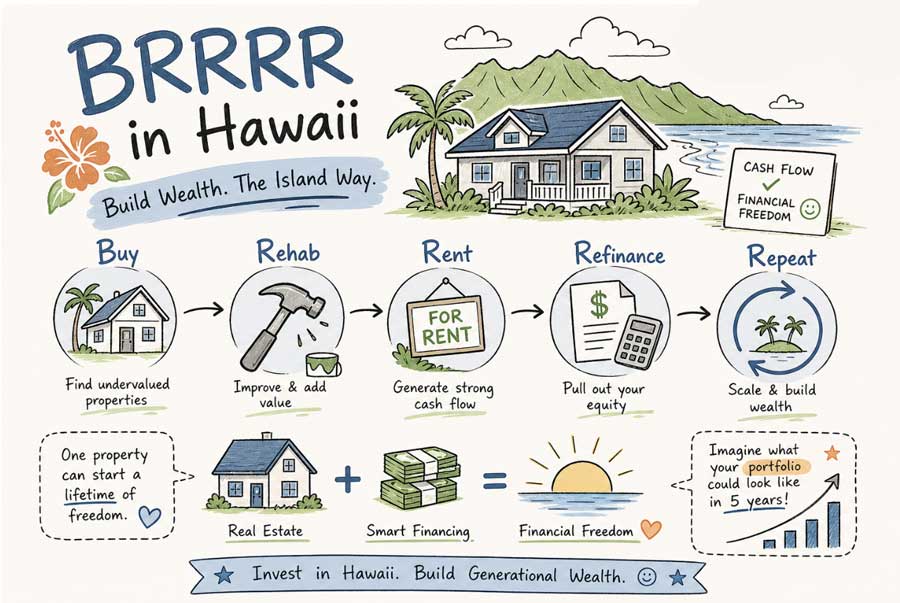
The most efficient way to execute the buy, rehab, rent, refinance, repeat cycle in Hawaii is through a single local lender who can fund both the bridge loan and the DSCR refinance. That’s exactly what Private Money Hawaii is built to do.Bridge Financing for Acquisition and Rehab
Private Money Hawaii offers asset-based bridge financing for the purchase and rehab of distressed properties across Oahu, Maui, the Big Island, and Kauai. The program is structured around Hawaii’s real permitting timelines, phased construction draws, no W-2 or income documentation required, and LTV up to 70%. When a county takes 90 to 104 days to issue a permit and your loan is accruing interest the entire time, having a lender whose draw structure accounts for that timeline is a material advantage. Learn more about bridge financing options in our Bridge Loans for Real Estate Investors Explained guide.
DSCR Refinance to Recycle Your Capital
Once the property is stabilized and rented, Private Money Hawaii’s DSCR refinance program qualifies borrowers on rental income rather than personal tax returns, consistent with how DSCR products are structured across the industry. That means the equity you built through the rehab can move into the next deal without waiting on W-2 documentation or personal income reviews. Having one local lender who understands both legs of the cycle reduces the coordination risk of using a mainland bridge lender and a separate DSCR lender with no knowledge of Hawaii’s zoning or appraisal environment. For an industry overview of available DSCR programs in the state, see this practical resource on DSCR loans in Hawaii, then compare lender-specific terms in our Hawaii Real Estate Investment Loans Guide.
Execute the BRRRR Strategy the Hawaii Way
The BRRRR strategy Hawaii investors use works, but the margin for error is thinner than on the mainland. Rehab costs, permitting timelines, STR regulations, and appraisal conservatism all require local expertise to navigate correctly. Investors who run honest numbers and work with the right financing partner are building real wealth across these islands.
The execution path is clear: buy with a verified ARV and comp-supported plan, control rehab costs against Hawaii’s cost premium, confirm your legal rental strategy before closing, and lock in your DSCR refinance lender before you ever make an offer. Every phase feeds the next, and a mistake in phase one compounds through all five.
If you’re evaluating a Hawaii deal right now and want to discuss bridge financing or how a DSCR refinance would structure on your specific property, reach out to Private Money Hawaii. One lender, both legs of the cycle, with the local market knowledge that actually moves deals forward in Hawaii.
Offering Rates Starts at 9%
At Private Money Hawaii, we are proud to fund commercial properties, multi-family residential, investment residential properties, fix and flip projects, land, and construction in Honolulu and across the Hawaii Islands.
Ready to Work with Hard Money Lenders Hawaii Investors Trust?
Act Fast with a Trusted Local Partner
Secure funding in as little as 7–14 days. No bank delays—just Honolulu hard money loans designed for investors who need speed and certainty.
Tailored Loan Programs
From Hawaii fix-and-flip loans in Oʻahu to bridge loans in Honolulu, DSCR rental financing, and construction loans across Hawaii, we customize terms around your project’s needs. With interest-only payment options, LTV up to 70%, and clear origination fees, you’ll have flexible funding that works for you.
Local Expertise You Can Trust
Led by veteran lender David Ige, a licensed mortgage broker in Honolulu with nearly 30 years of experience funding Hawaii investment property loans, we combine deep local insight with transparent terms to help investors succeed.
Private Money Hawaii
Address: 500 Ala Moana Blvd Downtown, Suite 7400, Honolulu, Hawaii 96813
Call: +1(808) 753-1204 or +1(808) 865-8055
Email: funding@privatemoneyhawaii.com
Looking for a reliable private money lender in Hawaii for your next real estate investment loan?
PRIVATE MONEY HAWAII
Private Money Hawaii
500 Ala Moana Blvd Downtown, Suite 7400, Honolulu, Hawaii 96813
Phone: (808) 865-8055 & (808) 753-1204
Email: funding@privatemoneyhawaii.com
Additional Info
NMLS#314018 | Excel Financial Services Inc. NMLS#319323